Get the guide

14-day guide · one step a day

Scratching furniture: your cat isn’t trying to ruin the sofa.

The Stressed Cat: a 14-day guide, a PDF and one email a day, to move the scratching somewhere you can both live with. Not to stop it: your cat needs to scratch. The same guide covers peeing outside the box, aggression and hiding too.

  • Day 0 · Rule out. The vet visit, with the paw and claw signs to mention, and when it can’t wait.
  • Days 1–3 · Read. A map of every scratch, when it happens, and why the post gets ignored.
  • Days 4–10 · Reset. On the scratching track, the right post in the right place, one step a day.
  • Days 11–14 · Review. What stays, what moves, and your plan for the weeks after.
  • The Stressed Cat · €37 at launch · a PDF and 14 daily emails · coming soon
  • The complete plan · €56.90 at launch · the guide, Little Wins and Felina Home, the plug-in diffuser · coming soon
  • Vet first, always
  • Arrives by email right after payment
  • 30-day money-back promise on the guide
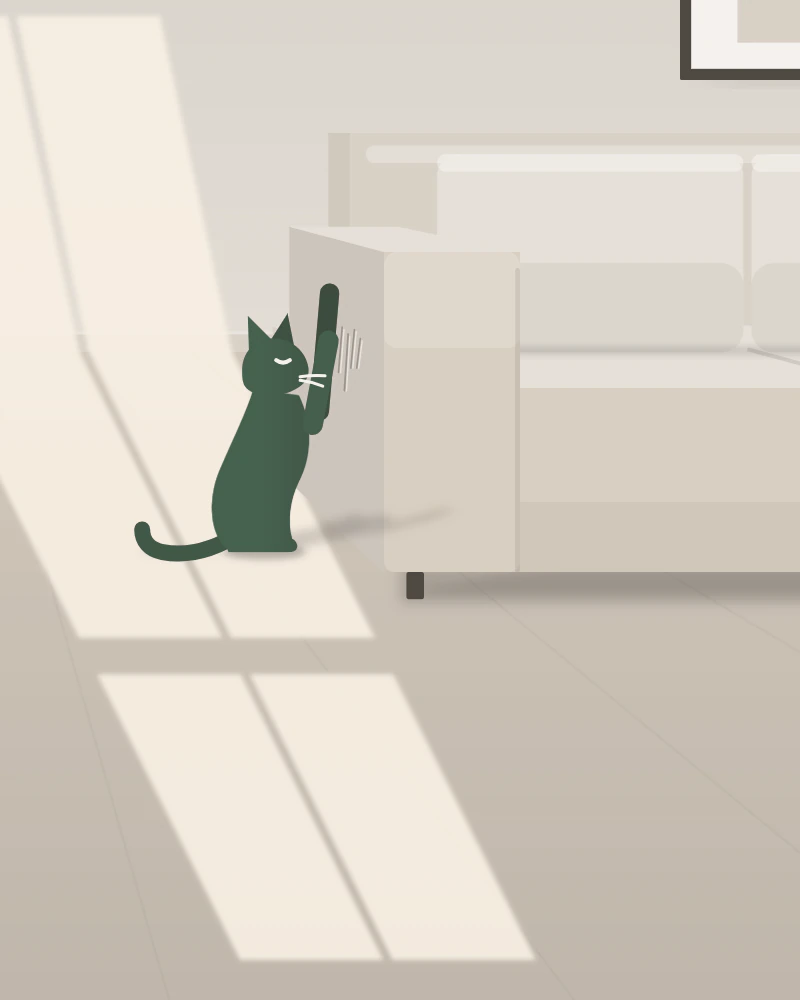
Illustration: the Felina cat standing on its back legs, scratching the arm of a pale sofa in warm window light.

Why it happens

Scratching is normal. The sofa is a message.

Scratching isn’t bad behaviour. It’s one of the most natural things a cat does, and it does three jobs at once.

It keeps claws in shape. Scratching pulls off the worn outer layer of each claw.

It’s a full-body stretch. Watch your cat after a nap: the first thing many of them do is reach up and pull.

It leaves a message. Cats have scent glands between the pads of their paws. Scratching leaves that scent, and visible marks, on the spot: a signpost that says “I live here”.

That third job explains most furniture scratching. Cats put their signposts where they matter: by the front door, near windows, beside the places they sleep, and on the big, central things that smell of the household. The sofa ticks every box. It’s in the middle of the room, it smells of you, and everyone walks past it.

So the goal is never to stop your cat scratching. It’s to move the scratching somewhere better, once you understand why they chose the sofa.

Why it can suddenly get worse

Some scratching is just a cat being a cat. But if your cat has started scratching more, or in new places, the full glass can be part of why.

Think of your cat’s day as a glass of water. Every small thing that bothers them adds a little.

A new cat has moved in. A drop.

The neighbour’s cat sits on the windowsill at dusk. A drop.

The new sofa smells of the shop, not of home. A drop.

Long, quiet days alone, then a rush of excitement when you walk in. A drop.

Each drop makes the signpost job feel more urgent. A cat with a full glass has more to say, and says it in more places: the door frame, the carpet on the stairs, the arm of the sofa by the window.

  • the post
  • its place
  • changes at home
  • another cat
  • something outside
Each small stress adds a little. More scratching, in more places, is what you see.

It’s a picture, not a scientific model. But it explains why a new post can save the sofa while the scratching moves to the door frame: the post took care of the claws, not the message. The guide looks at both.

You couldn’t have known

Most scratching posts are made to fit a shelf and a budget, not a cat. They’re short, light and covered in soft carpet, and they end up somewhere tidy, out of the way. Which is exactly where a signpost is no use.

And nobody tells you that cats want to stretch at full length, that some prefer to scratch flat along the floor, or that the rough weave and tall, solid arm of a sofa are close to perfect for claws.

Your cat isn’t being naughty or spiteful. You haven’t failed them. You bought a post, which is more than many people do. It just wasn’t the right one, in the right place, yet.

Why what you’ve tried hasn’t stuck

Each of these makes sense. Each one tries to stop the scratching, when what helps is moving it.

Shouting, clapping or a water spray. Your cat doesn’t learn where to scratch. They learn to be wary of you, and to scratch when you’re out of the room. And it adds to the glass.

A post across the room. A signpost in the wrong place. Your cat wants it where the message matters: next to the sofa, not in the corner.

A second post, just like the first. Same height, same wobble, same soft carpet. Your cat has already said no to it once.

Covering everything at once. If every favourite spot disappears and nothing better takes its place, the scratching moves to the next thing: the stairs, the door frame, the bed.

Trimming the claws, and stopping there. It helps the sofa, and the guide shows a gentle weekly check for it, trimming only what’s too long. But it doesn’t touch the need to scratch, or the message.

What these have in common: they deal with the marks, not the reasons. The guide starts with the reasons.

A word about declawing

If someone has suggested it, we understand why it can sound like an answer when the sofa is in shreds. The guide never suggests it, and here’s why. Declawing isn’t a nail trim. It’s an operation that removes the last bone of each toe. It takes away the way a cat stretches, looks after their claws and says “I live here”, and the need to scratch is still there afterwards. In many countries it isn’t allowed at all. There are kinder ways through this, and they’re what the guide is for.

Why the sofa wins, and how to check yours

These are the five places the guide looks first. You can start checking tonight.

1. The post doesn’t suit your cat

Too short, too light, or the wrong surface. To check: can your cat stretch at full length on it, front paws high? Does it move or tip when they pull? Is it soft carpet, when the sofa is a rough weave? What your cat scratches now tells you what they like.

2. It’s in the wrong place

Tucked away, far from where the scratching happens. To check: is the post next to the scratched spot, or across the room? Is there one near where your cat sleeps, and by the doorways they use most?

3. Upright or flat

Some cats scratch up, some scratch along. To check: where are the marks? Up the arm of the sofa and the door frame, or along the rug, the doormat and the carpet on the stairs? An upright post is easy to walk past for a cat who scratches flat.

4. The moments with nowhere to go

Waking up, the welcome home, after a meal, after a long stare out of the window. To check: when do you hear it? If it’s the same moments every day, the post needs to be where your cat is at those moments.

5. More to say

More scratching, or scratching in new places, after something changed. To check: has a new cat, a new sofa, a move or a new routine arrived lately? Is the scratching near doors and windows? Is there a cat outside, or tension with another cat at home?

It’s normal to find more than one. Days 1–3 of the guide help you put yours in order, so you know what to change first.

The Stressed Cat

The full plan, by email once sales open

The Stressed Cat, with its scratching track: a PDF and 14 daily emails, one step at a time, starting with your vet. It arrives by email right after payment.

€37One payment, yours to keep

  • 30-day money-back promise on the guide
  • Your EU right of withdrawal ends once the guide is delivered, with your consent

The Felina method

Rule out, Read, Reset, Review

Four phases, one step a day. Here’s what each means for scratching.

  1. Day 0 · Rule out. The vet visit first, with the paw and claw signs to mention. And why declawing is never an option.
  2. Days 1–3 · Read. A map of every scratch: the surface, the height, upright or flat. When it happens, and what came just before. Why the post you bought is ignored. Day 3 ends with your reasons in order.
  3. Days 4–10 · Reset. One step a day: the right post, the right place, the post made the best spot in the room, and the furniture made less interesting, kindly. Then claws, what may be behind extra scratching, and the rhythm of the day. Each step works in a small flat, a rented home, with several cats, or with long days out.
  4. Days 11–14 · Review. Your notes against Days 1–3: which posts and covers stay, which move, where to add one, and what to do if not much has changed.

Three rules run through it all: one change at a time, time for each change before you judge it, and a line of notes a day.

Fourteen days is the length of the guide, not a deadline for your cat. Habits take time to move, and some cats need longer. The guide ends with Keep: a weekly check for six weeks, and when the furniture covers can come off.

What’s inside

What’s inside: The Stressed Cat

One guide for the four problems where stress often plays a part. You follow the scratching track; the other three are there if you need them. A PDF to keep, with a contents page that takes you straight to your track, and one email a day.

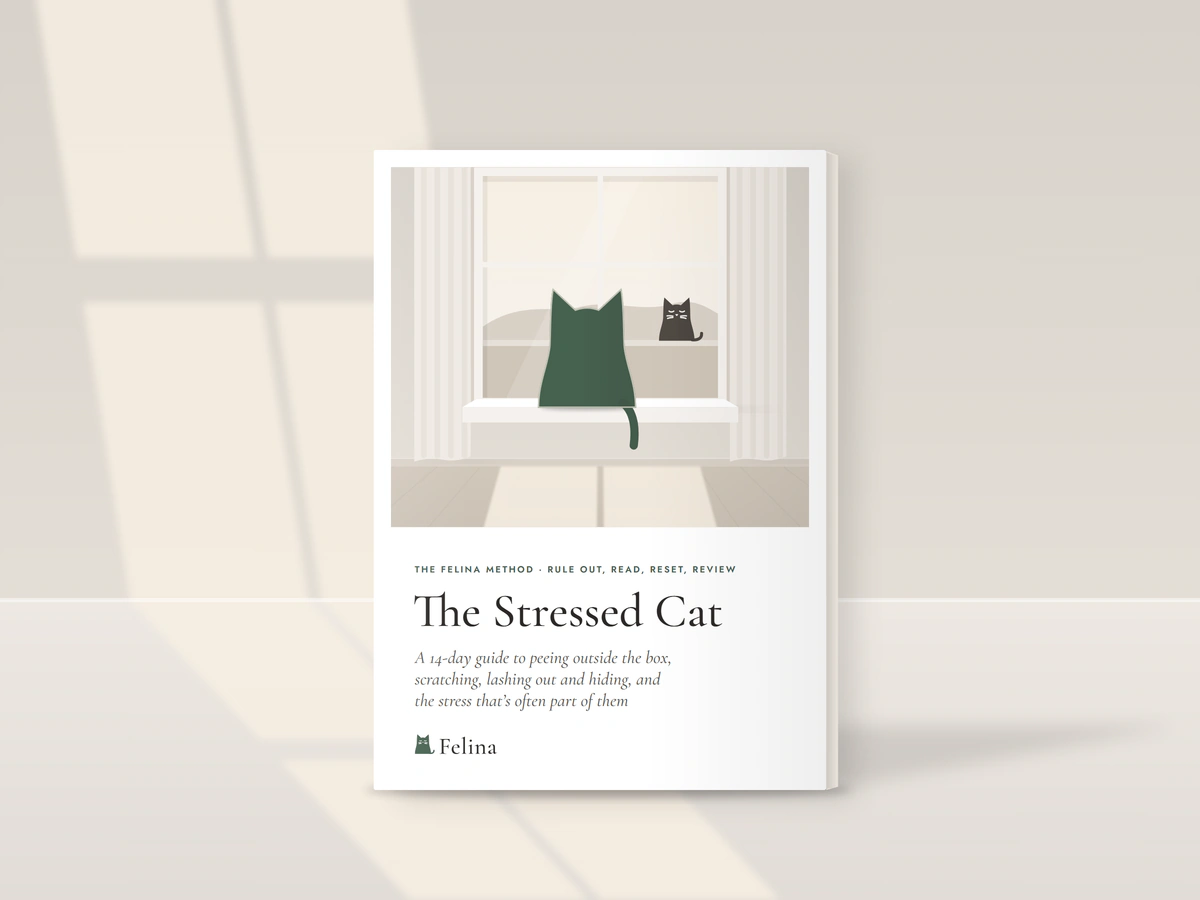
Illustration: The Stressed Cat as a printed booklet standing in window light, its cover showing the Felina cat on a windowsill above the title

Concept image. Final packaging in development.

Three parts, four tracks

  • Part 1, for every cat: before you start, the full glass and the three rules; Day 0, the vet visit, with the “go today” signs for each problem; Days 1–3, the home map, the signs and what fills the glass, ending with where to start if you see more than one problem.
  • Part 2, the scratching track: Days 4–10, one step a day: the right post, in the right place, made the best spot in the room, the sofa made less interesting, kindly, then claws, what may be behind extra scratching, and play. With the questions owners ask most, such as a cat who ignores every post, or the carpet on the stairs.
  • The other three tracks: peeing outside the box, aggression and hiding, each readable on its own, if you see more than one problem.
  • Part 3, for every cat: Days 11–14, Review: reading your notes, what stays, and what to do if not much has changed. Then Keep: a weekly check for six weeks, and what to do after a setback.
  • Twelve printable sheets: eight for every cat, and one for each track, listed below.

The 14 days, one email each

Day 0 comes in the delivery email, with the guide and the vet sheet. It asks which problem you’re seeing: choose scratching furniture, and from the next morning one email a day brings that day’s step on the scratching track, for Days 1 to 14.

Day 0 · Rule out

  • Your guide is here. Start with Day 0: the vet.

Days 1–3 · Read, for every cat

  • Day 1: draw a map of your home
  • Day 2: read the signs
  • Day 3: find the drops in the glass

Days 4–10 · Reset, on the scratching track

  • The evening of Day 3: a plug-in diffuser, the first change
  • Day 4: the post your cat actually wants
  • Day 5: put it where the damage is
  • Day 6: make the post the best spot in the room
  • Day 7: make the sofa less interesting, kindly
  • Day 8: claws, one paw at a time
  • Day 9: what may be behind extra scratching
  • Day 10: play first, then rest

Days 11–14 · Review, for every cat

  • Day 11: what your notes are telling you
  • Day 12: keep it, adjust it or step back
  • Day 13: if not much has changed
  • Day 14: your plan for the weeks after

Twelve printable sheets

  • The vet visit sheet
  • The home map
  • The 3-day observation diary
  • The signs chart
  • My drops, in order
  • The change log
  • The 14-day progress sheet
  • The weekly check, for after Day 14
  • For the scratching track: the post checklist and the claw-trimming steps
  • And one for each of the other three tracks

What you’ll do, day to day

Each morning: one email with the day’s step. Do the one thing it asks, and add a line to your progress sheet. The PDF holds the detail and the sheets.

On the evening of Day 3: a plug-in diffuser goes in, in the room your cat uses most, and stays on. It’s one of the changes, so it gets a day of its own, before the first step of your track. Any diffuser of this kind will do.

On the days that use a reward: Day 6 rewards every scratch on the post, and Day 8 gives a treat after each paw. Little Wins, our treats, are made for those moments, and the method kit brings them every 8 weeks.

Before you buy a new post: wait for Days 3 and 4. They tell you which height, surface and direction your cat wants, so you buy once.

Four things you can try tonight

  1. Put the post where the scratching is. Right in front of the scratched arm of the sofa, not across the room. Once it’s being used, you can move it a little at a time.
  2. Give it the wobble test. If your cat can’t stretch fully, or it moves when they pull, it isn’t the right post yet. For a cat who scratches rugs, lay a flat scratcher on the floor.
  3. Cover the scratched spot, for now. A thick throw over the arm while the new habit forms. Never punishment, just a change of scene.
  4. Make the post interesting. Drag a wand toy across it, and reward your cat when they use it.

Never shout or spray water when your cat scratches. It adds to their glass, and the scratching usually moves somewhere you can’t see it.

Is this guide for you?

It’s for you if your indoor or mostly indoor cat scratches the sofa, chairs, carpets, door frames or wallpaper, and you’ve bought a post they ignore. Kittens, adult cats and older cats; one cat or several; rented flats where the damage matters.

See your vet first if the scratching changed suddenly, or your cat limps or seems sore. Ask about a veterinary behaviourist if it comes with fighting between cats, spraying, or a cat who seems on edge most of the day, and nothing has changed after the 14 days.

It isn’t for you if you want your cat to stop scratching altogether. No cat should, and the guide won’t try.

The Stressed Cat

Start with the guide

Launch prices, VAT included. Sales open soon. Your guide arrives by email right after payment: the PDF and Day 0, the vet check. Then one email a day for 14 days.

The Stressed Cat

The guide, with the scratching track

€37

One guide for the four problems where stress often plays a part: a PDF and 14 daily emails, one step a day, starting with your vet. One payment, yours to keep.

  • The PDF, with twelve printable sheets
  • 14 daily emails, on the scratching track
  • Arrives by email right after payment

Get the free preview

The complete plan

The guide and the home set

€56.90

€76.80 if bought separately · €56.90 together · you save €19.90 (25%)

The guide, plus Little Wins and Felina Home, the plug-in diffuser, in one order. The guide arrives by email right after payment; the rest comes by post.

Inside, at single prices

  • The Stressed Cat, the guide€37
  • Little Wins, one 4-week bag€9.90
  • Felina Home, the diffuser with its first refill€29.90

Get the free preview

Every product on its own
  • 30-day money-back promise on the guide
  • Your EU right of withdrawal ends once the guide is delivered, with your consent
  • Payments handled by Stripe

Before you pay

The rules, in plain words

Money back on the guide for 30 days. Try the guide for 30 days from the day it arrives. If it isn’t right for you and your cat, write to us and we refund you in full, even if you’ve started it.

Your right of withdrawal on the guide. EU law gives you 14 days to withdraw from a purchase. For a guide, that right ends once it’s delivered: at checkout you ask for it to be delivered straight away, and you accept that the right of withdrawal ends when it is. Until then, you can still withdraw.

Little Wins, Felina Home and the method kit. For Little Wins, Felina Home and its refills, and each delivery of the method kit, you have 14 days from the day they arrive to withdraw, as EU law gives you, and we refund what you paid for them, with the standard delivery cost. The terms of sale, published when sales open, will have the details.

To ask for your money back, send one email to hello@felinacatcare.com from the address you used to pay. No form.

Questions

Before you start

Should I have my cat declawed?

No, and the guide never suggests it. Declawing removes the last bone of each toe. It takes away how a cat stretches and marks their home, and the need to scratch stays. Moving the scratching works with your cat, not against them.

Will trimming my cat’s claws stop it?

Trimmed claws do less damage, which helps the sofa while you work on the reasons. They won’t stop the need to scratch. Day 8 has a gentle weekly check, one paw at a time, trimming only the claws that are too long, and your vet can show you how far to cut.

My cat only scratches when I come home. Why?

That’s often excitement and greeting: a big stretch and a signpost in one. A post by the front door gives that moment somewhere to go. It’s part of Day 10.

I have more than one cat. Does that change anything?

Often, yes. Cats in the same home can scratch more to mark their part of it, and each may need their own post, in their own spot. Each day of the scratching track has a note for homes with several cats.

We rent, and there’s no room for a post by the sofa.

Every Reset step says how to do it in a rented home, and the track’s questions cover homes where the post can’t go next to the sofa. There’s usually a way: a flat scratcher, or a post at the other end.

My kitten scratches everything. Is it too early?

It’s a good time to start. Kittens are still learning where scratching feels best, so the right post in the right places now can save a lot later. The guide is written for kittens, adult cats and older cats.

Will it work, and how quickly?

We can’t promise that, and we’d be wary of anyone who does. Every cat and every home is different. What the guide gives you is a clear way to find why your cat chose the sofa and what to change, step by step.

Does the guide cover the other problems too?

Yes. The Stressed Cat has a track for each of the four problems where stress often plays a part: peeing outside the box, aggression and hiding, as well as scratching furniture. You follow one track at a time, and if you see more than one problem, the guide tells you where to start.

Where do Little Wins and the diffuser come in?

The guide is the method, and the changes you make at home are where things happen. The method kit brings what the method uses again and again: Little Wins for the reward steps, a new toy for play, refills for the diffuser and the next printable step. So it’s all at hand, and it’s easier to keep going. Little Wins are treats and Felina Home is a plug-in diffuser: neither is a medicine, and neither replaces your vet.

What is Felina Home? Is it a medicine?

No. It’s a plug-in diffuser for the home: it releases a synthetic copy of the pheromone cats leave when they rub their cheeks on furniture and people. It isn’t a medicine, and it doesn’t replace your vet. In the guide, it goes in on a day of its own, in the room your cat uses most. See Felina Home.

When does the guide arrive?

Right after payment, by email: the PDF and Day 0, the vet check. The 14 daily emails start the next morning.

Something else? See all questions or write to our team at hello@felinacatcare.com.

The same guide

If there’s more going on at home

The Stressed Cat has a track for each of these, so one guide covers them all.