Get the guide

14-day guide · one step a day

Fear and hiding: help your cat feel safe enough to come out.

Under the bed when the doorbell rings. Gone all evening when friends come round. A rescue cat who has never really settled, or a cat who hasn’t been the same since the move. The Stressed Cat, our 14-day guide, helps a frightened cat feel safe at home, at their own pace, without forcing anything. The same guide covers peeing outside the box, scratching and aggression too.

  • Day 0 · Rule out: a gentle vet check, especially if the hiding is new
  • Days 1–3 · Read: where your cat hides, when, and what sends them there
  • Days 4–10 · Reset: on the fear and hiding track, more safe places, a predictable day, one small step at a time
  • Days 11–14 · Review: what changed, what to adjust, and the next small step
  • The Stressed Cat · €37 at launch · a PDF and 14 daily emails · coming soon
  • The complete plan · €56.90 at launch · the guide, Little Wins and Felina Home, the plug-in diffuser · coming soon
  • 30-day money-back promise on the guide
  • Vet first, always
  • Arrives by email right after payment
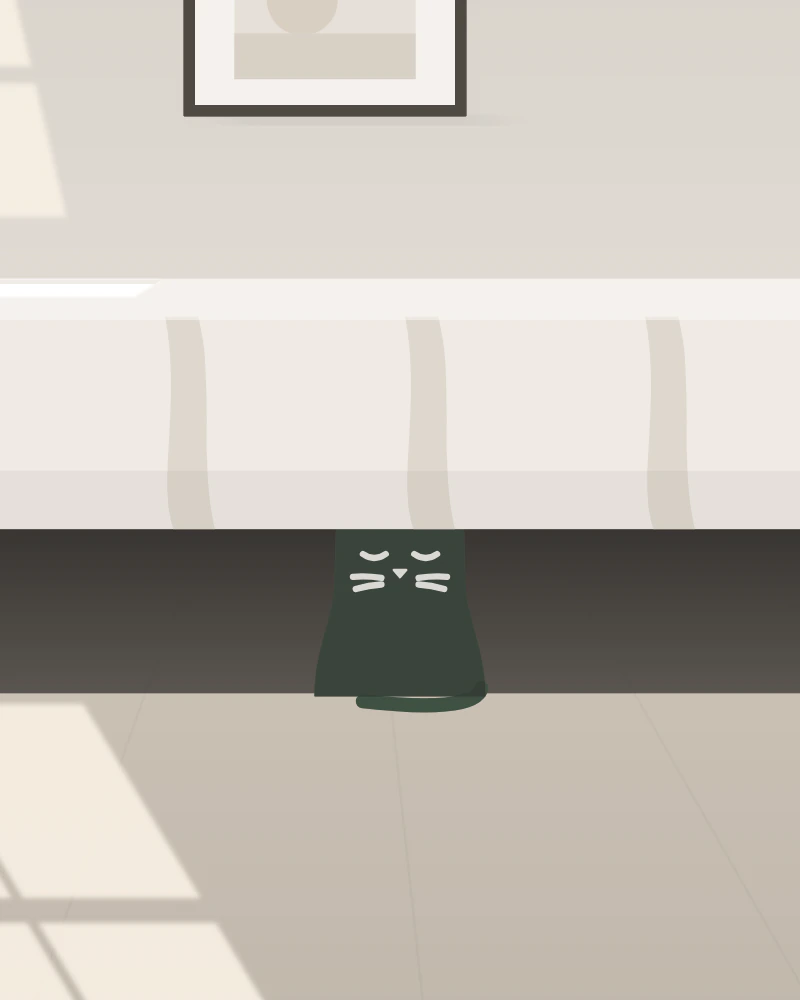
Illustration: the Felina cat tucked under a bed in a sunlit room, half hidden in the shadow below the bedspread

Go to the vet today if your cat hides and won’t eat for a day, is breathing fast or with their mouth open, can’t pee, is vomiting again and again, or seems weak or in pain.

If the hiding is new or sudden, the guide’s Reset steps wait until your vet has seen your cat. Day 0 shows you how to make the trip easier for a frightened cat, and what to tell the vet.

Ask your vet about a veterinary behaviourist if the fear is so strong that your cat stops eating, using the box or grooming, or hurts themselves trying to escape.

Why it happens

It isn’t shyness. It’s a cat keeping themselves safe.

Cats are hunters, but they’re also small animals that bigger animals hunt. Part of every cat is always checking: is this safe? Can I get away if it isn’t?

A cat feels safe when home is predictable, when they can see what’s coming, and when there’s always a way out and a place to go. When something feels like a threat, a stranger, a bang, a dog, the safest move is to get out of sight. That’s what hiding is: not a problem in itself, but the way a frightened cat looks after themselves.

It becomes a problem when it takes over. When your cat spends most of the day hidden, won’t eat or use the box while anyone’s around, or bolts at ordinary sounds. The answer isn’t fewer hiding places. It’s a home that feels safe enough to come out into. So two rules hold all the way through the guide: never take a hiding place away, and never pull a cat out.

Why it never seems to get better

Think of your cat’s day as a glass of water. Every small thing that frightens them adds a little.

The doorbell and the delivery driver, three times a week. A drop.

A toddler who loves the cat, loudly. A drop.

The washing machine on spin, right next to the food bowl. A drop.

Building work next door, every morning. A drop.

Your cat copes with each one. Until the glass is full, and then everything feels like too much: footsteps on the stairs, a cupboard door, you walking into the room. Under the bed becomes the one place the glass stops filling. And while the drops keep coming, it never empties enough for your cat to come back out.

  • The doorbell
  • The toddler
  • The washing machine
  • The building work
  • The dog
Each small fright adds a little. Hiding is what you see.

That’s why coaxing a cat out rarely lasts, and why waiting rarely does either. The way forward is to take out the biggest drops, one at a time, and make the rest of home feel safe, so your cat chooses to come out.

You couldn’t have known

Most of us were taught that a scared cat needs to “get used to it”: bring them out to meet visitors, hold them so they learn people are kind, carry them through the noise. It feels caring. To a frightened cat, it’s being trapped with the thing they fear.

We also miss how much of a cat’s day we can’t see: the cat at the window, the smell of a dog on a visitor’s coat, the boiler starting at three in the morning. And some cats arrive with a past. A stray who never met people as a kitten, a shelter cat after weeks of noise and strangers. You didn’t cause that, and it isn’t something a cat simply grows out of.

Your cat isn’t unfriendly. You haven’t failed them. You’ve both been doing your best with what you knew. This page is just more to know.

Why what you’ve tried hasn’t stuck

Most owners have tried a few of these. Each one makes sense, and each one leaves something out.

Pulling them out, or carrying them to meet people. It teaches your cat that even the hiding place isn’t safe, and that hands can grab. Next time they hide deeper, for longer.

Blocking off the hiding place. Under the bed is closed off, so the cat has to be “out”. A frightened cat with nowhere to go doesn’t feel braver. They feel trapped, and find somewhere worse, or lash out.

Facing the fear head on. The hoover run right next to them, the visitor who insists on a cuddle. Fear usually grows this way, rather than shrinks.

Following them around with treats. Kind, and too close. A treat held out by a hand that keeps coming nearer is a treat many timid cats won’t take.

Leaving them completely alone. Gentler than forcing, and sometimes right for a few days. But if nothing about home changes, there’s nothing new to come out for.

A spray or a plug-in, on its own. The guide has a plug-in diffuser among its changes, never instead of them: on its own, it can’t move the food closer to the hiding place or quieten the doorbell.

What these have in common: they’re guesses, one at a time, without first finding out what fills the glass. The guide starts there.

The common causes, and how to recognise yours

These are the causes the guide helps you find in Days 1–3. You can start noticing tonight, without going near your cat.

1. A new home

A newly adopted cat, a rescue, or a cat after a move. Hiding for days or weeks, coming out only at night, eating only when the house is quiet.

Ask yourself. How long since the change? Does your cat have one quiet room with everything they need? Are they exploring a little further, even slowly?

2. People

Visitors, children, or one particular person. Your cat vanishes when the doorbell goes and stays gone long after the guests leave, or avoids one member of the family.

Ask yourself. Is it everyone, or someone? Do visitors try to touch or pick up the cat? Do children follow them, or reach into hiding places?

3. Noise

Building work, a busy street, fireworks, storms, the hoover, a door that slams. Bolting at sudden sounds, hiding at the same times every day.

Ask yourself. Does it happen at set times? Is the food bowl, the box or your cat’s bed next to something loud?

4. Another animal

A dog in the home, a cat they’re avoiding, or a cat outside the window. Your cat keeps to one room, travels along the tops of furniture, or hides when the other animal is near.

Ask yourself. Can your cat reach food, water and a box without passing the other animal? If your cats also fight, see aggression: the guide has a track for it too.

5. A cat who never learned the world was safe

A former stray, or a cat who didn’t meet many people, places and sounds as a kitten. Timid from the start, rather than changed. Some cats are simply more careful by nature, too.

Ask yourself. Has your cat always been like this? Do they relax with one person, or in one place? That’s where the guide begins: with what already feels safe.

6. A frightening moment

A fall, a trip to the vet, a dropped pan, a child who grabbed too hard. A cat who changed after one particular day, sometimes one you didn’t notice.

Ask yourself. Is it tied to one room, one object or one event? If it started suddenly, see your vet first.

7. Pain or illness

A cat who used to be sociable and now hides, especially if they’re eating less, grooming less or moving stiffly.

Ask yourself. Nothing: book the vet. This is the one cause you can’t work out at home.

It’s normal to recognise more than one. A cat who never met many people as a kitten will find a move harder, and a noisy flat harder still. The guide helps you put them in order and choose what to change first.

The Stressed Cat

The full plan, by email once sales open

The Stressed Cat, with its fear and hiding track: a PDF and 14 daily emails, one step at a time, starting with your vet. It arrives by email right after payment.

€37One payment, yours to keep

  • 30-day money-back promise on the guide
  • Your EU right of withdrawal ends once the guide is delivered, with your consent

Rule out, Read, Reset, Review: the method, applied to fear

  1. Day 0 · Rule out. A gentle vet check, especially if the hiding is new: how to make the trip easier, what to tell the vet, and the signs that mean “go today”.
  2. Days 1–3 · Read. Every hiding place, mapped room by room. What fear looks like in your cat’s body, the small signs of curiosity and confidence, and the distance at which your cat stays relaxed. By Day 3, the triggers, in order.
  3. Days 4–10 · Reset. One change a day: more safe places, food and a box within reach, a predictable day, letting your cat come to you, play from a distance, the trigger made smaller, and a plan for the hard days. Your cat never has to give up a hiding place.
  4. Days 11–14 · Review. Keep, adjust or slow down, change by change, and what to look at again if little has changed. You leave with the next small step and a weekly check.

Fourteen days is the length of the guide, not a deadline for your cat. Frightened cats set the pace, and some need much longer. Progress often looks small: a meal eaten with you in the room, a cat who watches the visitor from the doorway instead of from under the bed. The guide helps you notice it.

What’s inside

What’s inside: The Stressed Cat

One guide for the four problems where stress often plays a part. You follow the fear and hiding track; the other three are there if you need them. A PDF to keep, with a contents page that takes you straight to your track, and one email a day.

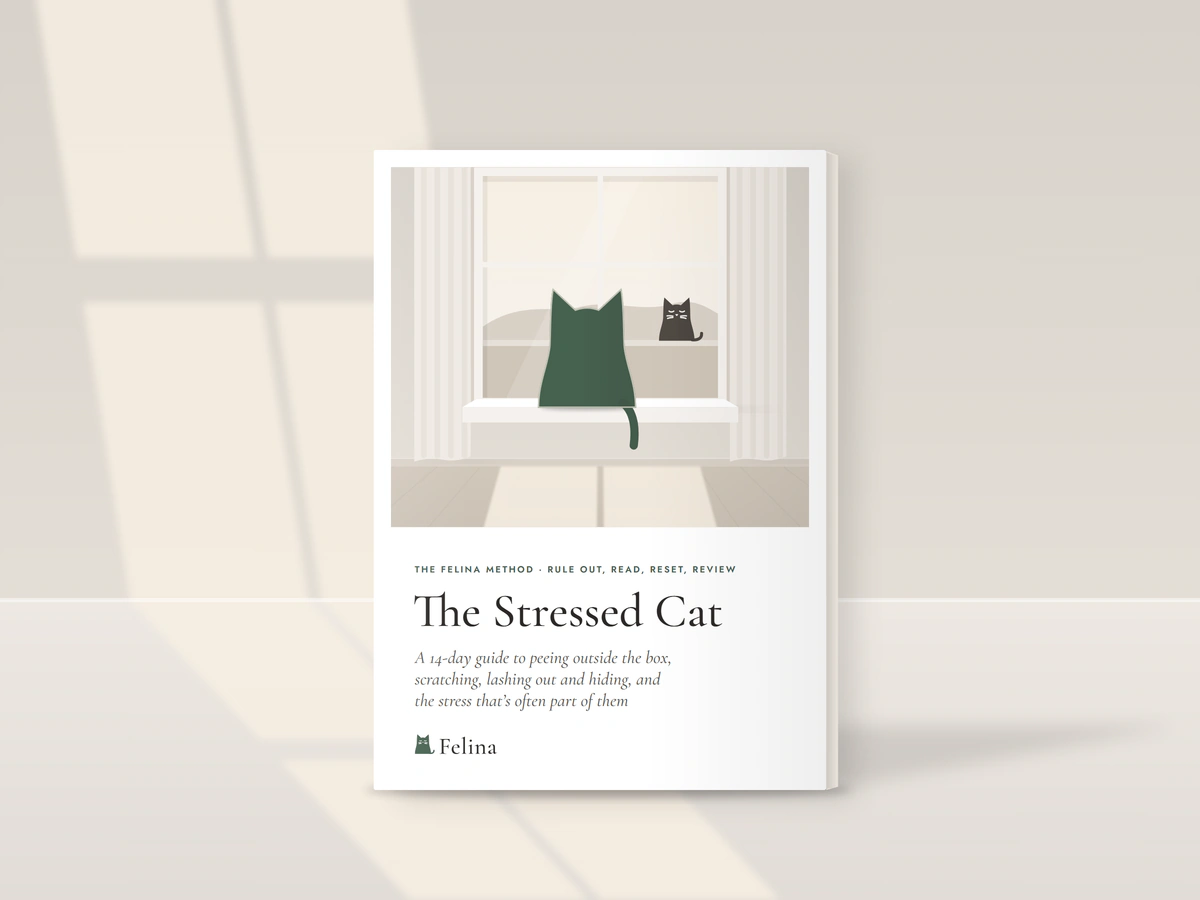
Illustration: The Stressed Cat as a printed booklet standing in window light, its cover showing the Felina cat on a windowsill above the title

Concept image. Final packaging in development.

Three parts, four tracks

  • Part 1, for every cat: before you start, the full glass and the three rules; Day 0, the vet visit, with the “go today” signs for each problem; Days 1–3, the home map, the signs and what fills the glass, ending with where to start if you see more than one problem.
  • Part 2, the fear and hiding track: Days 4–10, one change a day, at your cat’s pace: more safe places, food and a box within reach, a predictable day, letting your cat come to you, play from a distance, the scary thing made smaller, and a plan for the hard days. With the questions owners ask most, such as the newly adopted cat, or the cat who only comes out at night.
  • The other three tracks: peeing outside the box, scratching and aggression, each readable on its own, if you see more than one problem.
  • Part 3, for every cat: Days 11–14, Review: reading your notes, what stays, and what to do if not much has changed. Then Keep: a weekly check for six weeks, and what to do after a setback.
  • Twelve printable sheets: eight for every cat, and one for each track, listed below.

The 14 days, one email each

Day 0 comes in the delivery email, with the guide and the vet sheet. It asks which problem you’re seeing: choose fear and hiding, and from the next morning one email a day brings that day’s step on the fear and hiding track, for Days 1 to 14.

Day 0 · Rule out

  • Your guide is here. Start with Day 0: the vet.

Days 1–3 · Read, for every cat

  • Day 1: draw a map of your home
  • Day 2: read the signs
  • Day 3: find the drops in the glass

Days 4–10 · Reset, on the fear and hiding track

  • The evening of Day 3: a plug-in diffuser, the first change
  • Day 4: more hiding places, not fewer
  • Day 5: food and a box within reach
  • Day 6: the same day, every day
  • Day 7: let your cat come to you
  • Day 8: play from a distance
  • Day 9: the scary thing, but smaller
  • Day 10: a plan for the hard days

Days 11–14 · Review, for every cat

  • Day 11: what your notes are telling you
  • Day 12: keep it, adjust it or step back
  • Day 13: if not much has changed
  • Day 14: your plan for the weeks after

Twelve printable sheets

  • The vet visit sheet
  • The home map
  • The 3-day observation diary
  • The signs chart
  • My drops, in order
  • The change log
  • The 14-day progress sheet
  • The weekly check, for after Day 14
  • For the fear and hiding track: the hiding map and the visitor card
  • And one for each of the other three tracks

What you’ll do, day to day

Every day: one email, one step, one small thing to do, and a line in your diary. Most tasks take about 15 minutes, plus some quiet watching and a line of notes.

On the evening of Day 3: a plug-in diffuser goes in, in the room your cat uses most, and stays on. It’s one of the changes, so it gets a day of its own, before the first step of your track. Any diffuser of this kind will do.

What you’ll need: a few cardboard boxes or covered beds, a wand toy, treats your cat loves, and one quiet room. Nothing new to buy unless you want to.

Is this guide for you?

It’s for you if your cat hides for hours, runs from visitors, noises or other animals, or has never really settled, and you want to help without forcing anything. It works for rescued and newly adopted cats, after a move, in busy homes with children or a dog, and in small flats.

It isn’t for you if you’re hoping to turn a careful cat into a lap cat by a certain date. Some cats will always be watchful. The aim is a cat who feels safe at home, on their own terms.

The Stressed Cat

Start with the guide

Launch prices, VAT included. Sales open soon. Your guide arrives by email right after payment: the PDF and Day 0, the vet check. Then one email a day for 14 days.

The Stressed Cat

The guide, with the fear and hiding track

€37

One guide for the four problems where stress often plays a part: a PDF and 14 daily emails, one step a day, starting with your vet. One payment, yours to keep.

  • The PDF, with twelve printable sheets
  • 14 daily emails, on the fear and hiding track
  • Arrives by email right after payment

Get the free preview

The complete plan

The guide and the home set

€56.90

€76.80 if bought separately · €56.90 together · you save €19.90 (25%)

The guide, plus Little Wins and Felina Home, the plug-in diffuser, in one order. The guide arrives by email right after payment; the rest comes by post.

Inside, at single prices

  • The Stressed Cat, the guide€37
  • Little Wins, one 4-week bag€9.90
  • Felina Home, the diffuser with its first refill€29.90

Get the free preview

Every product on its own
  • 30-day money-back promise on the guide
  • Your EU right of withdrawal ends once the guide is delivered, with your consent
  • Payments handled by Stripe

Before you pay

The rules, in plain words

Money back on the guide for 30 days. Try the guide for 30 days from the day it arrives. If it isn’t right for you and your cat, write to us and we refund you in full, even if you’ve started it.

Your right of withdrawal on the guide. EU law gives you 14 days to withdraw from a purchase. For a guide, that right ends once it’s delivered: at checkout you ask for it to be delivered straight away, and you accept that the right of withdrawal ends when it is. Until then, you can still withdraw.

Little Wins, Felina Home and the method kit. For Little Wins, Felina Home and its refills, and each delivery of the method kit, you have 14 days from the day they arrive to withdraw, as EU law gives you, and we refund what you paid for them, with the standard delivery cost. The terms of sale, published when sales open, will have the details.

To ask for your money back, send one email to hello@felinacatcare.com from the address you used to pay. No form.

Questions

Before you start

Something else, before or during the guide? See all questions or write to us at hello@felinacatcare.com: our team answers by email.

It started suddenly. Should I begin here?

No, start with your vet. Hiding is one of the most common ways cats show pain or illness. Once your vet has seen your cat, the guide takes it from there.

Should I block off under the bed, so my cat can’t hide?

No. Hiding is how a frightened cat copes, and taking a hiding place away makes the fear stronger. The guide does the opposite: more safe places, in every room your cat uses, so the rest of home feels safe enough to come out into.

We’ve just adopted a cat who won’t come out. Is that normal?

It’s very common. Give them one quiet room with everything they need and a few places to hide, and let them explore further at their own pace. The guide has a section on newly adopted cats.

My cat hides from one person in the family.

Often it’s how that person moves or sounds, or one bad moment. The guide gives them a role: the quiet one who tosses treats from a distance and lets the cat decide when to come closer.

We’re moving soon. What can I do now?

Set up one quiet room in the new home before your cat arrives, with everything they need and things that smell of the old home. Let them stay there until they’re ready to explore, one room at a time.

What about fireworks and storms?

Close the curtains, put on gentle background sound, and have the quiet room and hiding places ready before it starts. Stay home if you can, and carry on as normally as possible. If your cat struggles badly every year, talk to your vet well before the date.

My cat only comes out at night.

That’s when the house is quiet, which tells you a lot. Day 6 builds a predictable day with quiet times, and Day 8 brings short, gentle play to the edge of the hiding place, so daytime can start to feel safe too.

My cat won’t take treats in front of me.

Common at the start. Toss the treat near the hiding place and walk away, or leave it there at night. Day 7 moves a little closer each day, only as fast as your cat allows.

Will it work, and how quickly?

We can’t promise that, and we’d be wary of anyone who does. Every cat and every home is different. What the guide gives you is a gentle, clear way to find what frightens your cat, and what to change, at their pace.

Does the guide cover the other problems too?

Yes. The Stressed Cat has a track for each of the four problems where stress often plays a part: peeing outside the box, scratching and aggression, as well as fear and hiding. You follow one track at a time, and if you see more than one problem, the guide tells you where to start.

Where do Little Wins and the diffuser come in?

The guide is the method, and the changes you make at home are where things happen. The method kit brings what the method uses again and again: Little Wins for the reward steps, a new toy for play, refills for the diffuser and the next printable step. So it’s all at hand, and it’s easier to keep going. Little Wins are treats and Felina Home is a plug-in diffuser: neither is a medicine, and neither replaces your vet.

What is Felina Home? Is it a medicine?

No. It’s a plug-in diffuser for the home: it releases a synthetic copy of the pheromone cats leave when they rub their cheeks on furniture and people. It isn’t a medicine, and it doesn’t replace your vet. In the guide, it goes in on a day of its own, in the room your cat uses most. See Felina Home.

I have two cats. Do I need two guides?

No. One guide covers every animal in the home: the steps are written for one-cat and multi-cat homes.

The same guide

If there’s more going on at home

The Stressed Cat has a track for each of these, so one guide covers them all.

  • Aggression towards other animals or people

    A frightened cat may lash out when cornered. If yours hisses, swats or bites, see this one too.

  • Peeing outside the box

    A cat too frightened to cross the house may stop using the box.

  • Scratching furniture

    Scratching is how cats mark home as theirs, and a confident cat scratches in the open.

  • The free preview

    The first five pages of the guide, for all four problems: the full glass, the vet checklist and what to try today. Free, no email needed.