Peeing outside the box: find the reason, then change it.
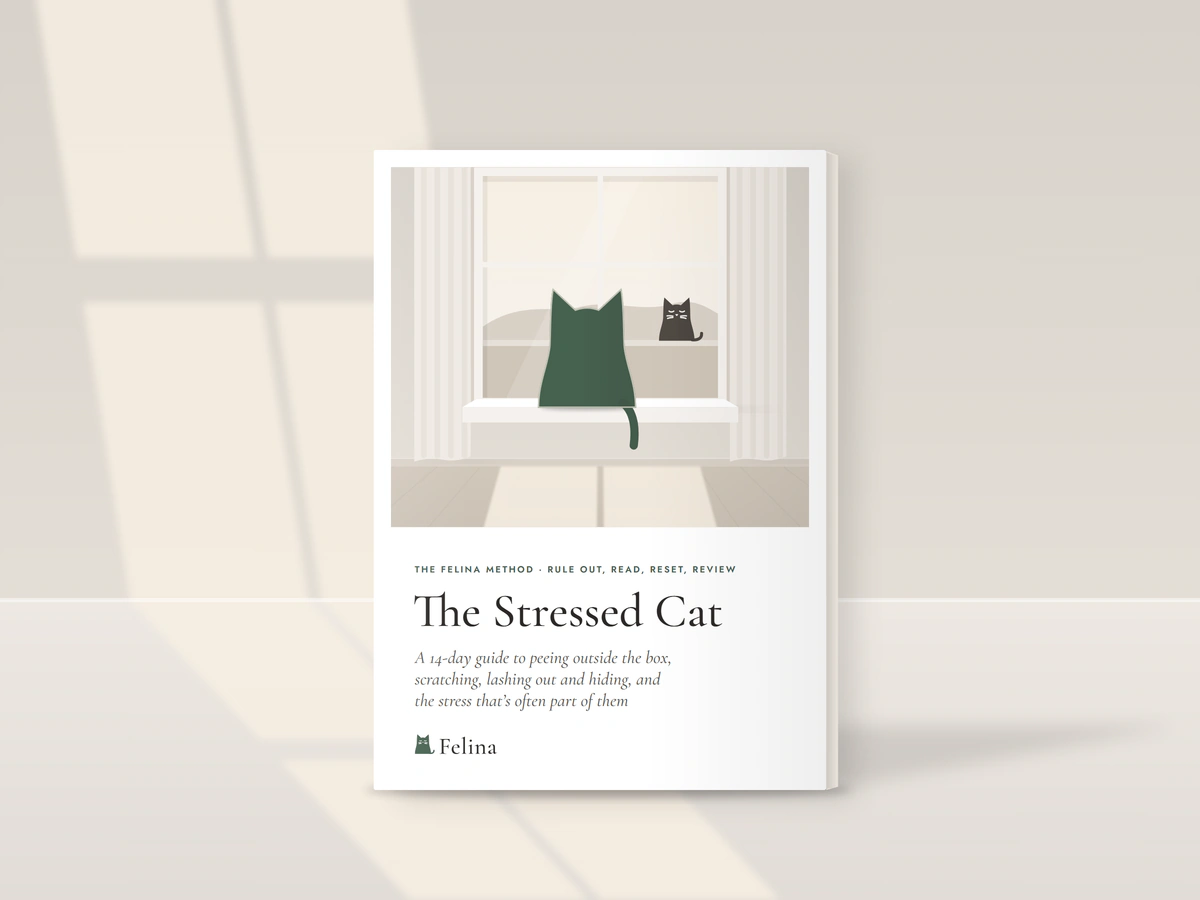
The Stressed Cat: a 14-day guide, a PDF and one email a day, from the vet visit to a new routine. Its litter box track takes you one step at a time, and the same guide covers the three other problems where stress often plays a part: scratching, aggression and hiding.
Day 0 · Rule out. The vet visit, and the signs that mean “go today”.
Days 1–3 · Read. A map of your home, the box audit and three days of notes.
Days 4–10 · Reset. On the litter box track, one step a day, in the right order.
Days 11–14 · Review. What changed, what stays, and your plan for the weeks after.
The Stressed Cat · €37 at launch · a PDF and 14 daily emails · coming soon
The complete plan · €56.90 at launch · the guide, Little Wins and Felina Home, the plug-in diffuser · coming soon
Cats need to feel in control of their territory: where they eat, sleep, watch, and go to the toilet. When something about the box, the home or the other animals feels wrong, many cats show it the only way they can.
It helps to know which of two things you’re seeing.
Peeing. Your cat squats and leaves a puddle on a flat surface: a rug, a bath mat, the bed, the floor beside the box. This usually means the box, or the way to it, feels wrong. Your cat wants to go. Just not there.
Spraying. Your cat stands with their back to a wall, a curtain or a door, tail up and quivering, and leaves a small amount at nose height. It’s a message to other cats, real or imagined: “this is mine”. It’s most often about territory: another cat, a cat outside, or big changes indoors.
Pooing outside the box belongs mostly with the first group: some cats won’t poo in a box they’ve peed in, especially if it isn’t cleaned often.
Different as they look, both come back to one thing: a cat who doesn’t feel in control of their space.
See your vet first, too, if your cat goes very often, cries in the box or there’s blood. If your cat isn’t neutered, ask about it: it changes a lot about spraying.
Why it seems to start overnight
Think of your cat’s day as a glass of water. Every small thing that bothers them adds a little.
The box is in the bathroom, and the door sometimes swings shut. A drop.
You switched to a scented litter because it smells nicer to you. A drop.
The other cat has started sleeping in the hallway outside the bathroom. A drop.
A cat from next door now crosses the garden at dusk. A drop.
Your cat copes with each one. Until the glass is full, and the next small thing, a visitor, a holiday, a new sofa, spills it over. The first puddle appears, and it looks as if it came from nowhere.
the box
its place
changes at home
another cat
something outside
Each small stress adds a little. The spill is what you see.
It’s a picture, not a scientific model, but it explains a lot. Why a fix helped for a week, then didn’t. Why mopping up, however well you do it, doesn’t stop the next one. The way forward is to find the biggest drops and take them out, one at a time. That’s what the guide is built to do.
You couldn’t have known
Nobody hands you a manual when you bring a cat home. And most of the things that matter to your cat are invisible to us.
Litter boxes are sold in sizes that suit shelves, not cats. Lids are sold because they hide the mess from people. Scented litters are made to please our noses, which are far less sensitive than a cat’s. A quiet kitchen corner seems a thoughtful place for the box, until you notice the food bowl is there too, and cats would rather not eat where they go.
Your cat isn’t being difficult. You haven’t failed them. You’ve both been doing your best with what you knew. This is just more to know.
Why what you’ve tried hasn’t stuck
Each of these makes sense, and each one leaves something out.
Moving the box. Sometimes right, often at random. A box moved to a busier spot, or moved every few days, is one more thing to get used to.
A second box next to the first. To a cat, two boxes side by side are one big box in the same place. If the place is the problem, it still is.
A new litter, overnight. The new one may be better. The sudden change can make things worse first.
Bleach or ammonia. These can leave a smell your cat reads as urine. You see a clean floor. They smell a toilet.
Telling them off. Your cat connects your reaction with you, not with the puddle. They learn to go where you can’t see.
A spray or a plug-in, on its own. The guide has a plug-in diffuser among its changes, never instead of them: on its own, it can’t move the box, make it bigger or add one for the other cat.
Ten tips at once. A new box, place and litter on the same weekend. If something works, you won’t know which.
What these have in common: they’re guesses, made without first finding out what’s filling the glass. The guide starts there.
The five most common reasons, and how to check yours
These are the five places the guide looks first. You can start checking tonight.
1. The box itself
Too small, covered, not clean enough, or a litter your cat dislikes. To check: is it at least one and a half times your cat’s length, nose to the base of the tail? Does it have a lid or a liner? Is the litter scented, or shallow? Is it scooped every day? Does your cat perch on the edge, or leave as fast as they can?
2. Where it is
A busy hallway, next to the food bowl, or beside a noisy machine. To check: can your cat see who’s coming while they’re in the box? Is there more than one way out, or could another animal block the only exit? Is it next to the washing machine, the boiler or the food?
3. Changes at home
A move, new furniture, a new person or a new pet. To check: did anything change in the weeks before it started? Building work, a new sofa, a baby, a holiday, new working hours? Is it happening on new things, or on things that smell of someone new?
4. Another cat
Competition for the box, the food or the best resting spots. To check: is there at least one box per cat, plus one, in different places? Does one cat sit near the box or in a doorway when the other wants to pass? Is there quiet staring, or one cat leaving when the other walks in?
5. Something outside
A cat at the window or in the garden. To check: is it happening near doors, windows or the cat flap? Have you seen a cat outside? Does your cat stare out at the same time every day, tail twitching?
It’s normal to find more than one. Days 1–3 of the guide help you find which one weighs most, and what to change first.
The Stressed Cat, with its litter box track: a PDF and 14 daily emails, one step at a time, starting with your vet. It arrives by email right after payment.
Your EU right of withdrawal ends once the guide is delivered, with your consent
The Felina method
Rule out, Read, Reset, Review
Four phases, one step a day. Here’s what each means for the litter box.
1Day 0 · Rule out. A vet visit before you change anything: what to say, what to ask, and the signs that mean “go today”.
2Days 1–3 · Read. A map of your home, the box seen the way your cat sees it, and three days of notes: where, when, what came just before, peeing or spraying. Day 3 ends with your reasons in order.
3Days 4–10 · Reset. One step a day: the old spots first, then the box, the litter, the place, enough boxes, and the window and the shape of the day. Each step works in a small flat, with several cats, or with long days out.
4Days 11–14 · Review. Your notes against Days 1–3: what stays, what to undo, and what to do if not much has changed.
Three rules run through it all: one change at a time, time for each change before you judge it, and a line of notes a day.
Fourteen days is the length of the guide, not a deadline for your cat. Some cats settle sooner, some take longer, which is why the guide ends with Keep: a weekly check for six weeks after Day 14.
What’s inside
What’s inside: The Stressed Cat
One guide for the four problems where stress often plays a part. You follow the litter box track; the other three are there if you need them. A PDF to keep, with a contents page that takes you straight to your track, and one email a day.
Concept image. Final packaging in development.
Three parts, four tracks
Part 1, for every cat: before you start, the full glass and the three rules; Day 0, the vet visit, with the “go today” signs for each problem; Days 1–3, the home map, the signs and what fills the glass, ending with where to start if you see more than one problem.
Part 2, the litter box track: Days 4–10, one step a day, for your kind of home: the old spots, the box, the litter, the place, enough boxes, a new job for the old spot, and the window. With the questions owners ask most, such as a cat who only pees on the bed, or two cats and one who won’t stop.
The other three tracks: scratching, aggression and hiding, each readable on its own, if you see more than one problem.
Part 3, for every cat: Days 11–14, Review: reading your notes, what stays, and what to do if not much has changed. Then Keep: a weekly check for six weeks, and what to do after a setback.
Twelve printable sheets: eight for every cat, and one for each track, listed below.
Day 0 comes in the delivery email, with the guide and the vet sheet. It asks which problem you’re seeing: choose peeing outside the box, and from the next morning one email a day brings that day’s step on the litter box track, for Days 1 to 14.
Day 0 · Rule out
Your guide is here. Start with Day 0: the vet.
Days 1–3 · Read, for every cat
Day 1: draw a map of your home
Day 2: read the signs
Day 3: find the drops in the glass
Days 4–10 · Reset, on the litter box track
The evening of Day 3: a plug-in diffuser, the first change
Day 4: the spots that keep calling your cat back
Day 5: a bigger, simpler box
Day 6: let your cat choose the litter
Day 7: a better place, without taking the old one away
Day 8: one box per cat, plus one
Day 9: give the old spot a new job
Day 10: the window, the routine and a quiet reward
Days 11–14 · Review, for every cat
Day 11: what your notes are telling you
Day 12: keep it, adjust it or step back
Day 13: if not much has changed
Day 14: your plan for the weeks after
Twelve printable sheets
The vet visit sheet
The home map
The 3-day observation diary
The signs chart
My drops, in order
The change log
The 14-day progress sheet
The weekly check, for after Day 14
For the litter box track: the box audit and the cleaning card
And one for each of the other three tracks
What you’ll do, day to day
Each morning: one email with the day’s step. Do the one thing it asks, and add a line to your progress sheet. The PDF holds the detail and the sheets.
On the evening of Day 3: a plug-in diffuser goes in, in the room your cat uses most, and stays on. It’s one of the changes, so it gets a day of its own, before the first step of your track. Any diffuser of this kind will do.
On the days that use a reward: any treat your cat loves works. Little Wins, our treats, are one option: you don’t need them.
With an enzymatic cleaner made for urine: on every accident, and on the old spots Day 4 helps you find.
How to clean an accident so it stops calling your cat back
Cats go back to places that smell like a toilet. Ordinary cleaners can leave traces you can’t smell and your cat can.
1Blot, don’t rub. Soak up what you can with kitchen paper. Rubbing pushes it deeper.
2Use an enzymatic cleaner. It’s made to break down what urine leaves behind. Use enough to reach as deep as the urine went.
3Let it work, and let it dry. Follow the time on the label, then let the spot dry on its own, with your cat out of the room.
4Skip bleach and ammonia. Don’t mix cleaners, and don’t add a scented spray on top.
5Find the old spots. A cheap ultraviolet torch, in a dark room, shows dried urine you can’t see. Clean those too.
Then make the spot a little less inviting for a while: a piece of furniture over it, or a door kept closed. Never punishment, just a change of scene.
Is this guide for you?
It’s for you if your indoor or mostly indoor cat pees, poos or sprays outside the box, and you’re ready to change a few things, one at a time, and keep a few notes. One cat or several, flat or house, home all day or out at work.
It isn’t for you if your cat seems unwell: see your vet first. Or if you’re hoping for a product that sorts it out with no changes at home. We don’t sell one, because we don’t think one exists.
The Stressed Cat
Start with the guide
Launch prices, VAT included. Sales open soon. Your guide arrives by email right after payment: the PDF and Day 0, the vet check. Then one email a day for 14 days.
The Stressed Cat
The guide, with the litter box track
€37
One guide for the four problems where stress often plays a part: a PDF and 14 daily emails, one step a day, starting with your vet. One payment, yours to keep.
€76.80 if bought separately · €56.90 together · you save €19.90 (25%)
The guide, plus Little Wins and Felina Home, the plug-in diffuser, in one order. The guide arrives by email right after payment; the rest comes by post.
Inside, at single prices
The Stressed Cat, the guide€37
Little Wins, one 4-week bag€9.90
Felina Home, the diffuser with its first refill€29.90
Our suggestion: if there have been accidents on rugs, sofas or beds, have an enzymatic cleaner made for urine ready. Old spots keep calling cats back.
30-day money-back promise on the guide
Your EU right of withdrawal ends once the guide is delivered, with your consent
Payments handled by Stripe
Before you pay
The rules, in plain words
Money back on the guide for 30 days. Try the guide for 30 days from the day it arrives. If it isn’t right for you and your cat, write to us and we refund you in full, even if you’ve started it.
Your right of withdrawal on the guide. EU law gives you 14 days to withdraw from a purchase. For a guide, that right ends once it’s delivered: at checkout you ask for it to be delivered straight away, and you accept that the right of withdrawal ends when it is. Until then, you can still withdraw.
Little Wins, Felina Home and the method kit. For Little Wins, Felina Home and its refills, and each delivery of the method kit, you have 14 days from the day they arrive to withdraw, as EU law gives you, and we refund what you paid for them, with the standard delivery cost. The terms of sale, published when sales open, will have the details.
To ask for your money back, send one email to hello@felinacatcare.com from the address you used to pay. No form.
Questions
Before you start
It started suddenly. Should I begin here?
No, start with your vet. Sudden changes can have medical causes. Once your vet has ruled them out, the guide helps you work on what’s happening at home. You can read Days 1–3 while you wait for the appointment.
My cat sprays rather than pees. Does the guide cover it?
Yes. Day 2 helps you tell the two apart, and the changes for spraying focus on territory: other cats, the view outside and big changes at home. If your cat isn’t neutered, talk to your vet first.
It only happens on the bed, or on clothes. Why?
Soft places that smell of you are common choices. Often your cat wants somewhere that feels safe, or something about the box is off. The litter box track answers exactly this.
Will it work, and how quickly?
We can’t promise that, and we’d be wary of anyone who does. Every cat and every home is different. What the guide gives you is a clear way to find what’s behind it and what to change, step by step.
Does the guide cover the other problems too?
Yes. The Stressed Cat has a track for each of the four problems where stress often plays a part: scratching, aggression and hiding, as well as peeing outside the box. You follow one track at a time, and if you see more than one problem, the guide tells you where to start.
Where do Little Wins and the diffuser come in?
The guide is the method, and the changes you make at home are where things happen. The method kit brings what the method uses again and again: Little Wins for the reward steps, a new toy for play, refills for the diffuser and the next printable step. So it’s all at hand, and it’s easier to keep going. Little Wins are treats and Felina Home is a plug-in diffuser: neither is a medicine, and neither replaces your vet.
What is Felina Home? Is it a medicine?
No. It’s a plug-in diffuser for the home: it releases a synthetic copy of the pheromone cats leave when they rub their cheeks on furniture and people. It isn’t a medicine, and it doesn’t replace your vet. In the guide, it goes in on a day of its own, in the room your cat uses most. See Felina Home.
What should I clean the old spots with?
An enzymatic cleaner made for urine, the kind sold for pet accidents: spots that still smell like a toilet to your cat keep calling them back. Day 4 of the litter box track shows you how to find every old spot and clean it in five steps.
When does the guide arrive?
Right after payment, by email: the PDF and Day 0, the vet check. The 14 daily emails start the next morning.